> For the complete documentation index, see [llms.txt](https://docs.ecotone.tech/llms.txt). Markdown versions of documentation pages are available by appending `.md` to page URLs; this page is available as [Markdown](https://docs.ecotone.tech/modelling/recovering-tracing-and-monitoring/resiliency/error-channel-and-dead-letter/dbal-dead-letter.md).
# Dbal Dead Letter
DBAL-based dead letter queue for storing and replaying failed messages
You want failed messages stored next to your application data so they survive a broker restart, can be queried with SQL, and replayed via a console command without writing custom tooling. The **Dbal Dead Letter** is a table in the same database your aggregates live in, holding every error message with its exception, headers, and payload — ready to be reviewed, replayed, or deleted.
## Dbal Dead Letter
Ecotone provides full lifecycle management of error messages via the [Dbal Module](/modules/dbal-support.md#dead-letter):
* Store failed Message with all details about the exception
* Allow for reviewing error Messages
* Allow for deleting and replaying error Message back to the [Asynchronous Message Channels](/modelling/asynchronous-handling.md)
## Installation
To make use of Dead Letter, we need to have [Ecotone's Dbal Module](/modules/dbal-support.md) installed.
## Storing Messages in Dead Letter
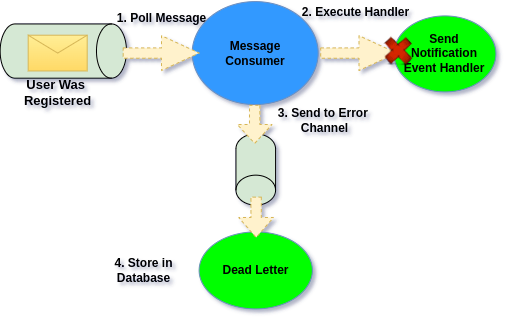
If we configure default error channel to point to **"dbal\_dead\_letter"** then all Error Messages will land there directly
Storing Error Messages once they failed directly in Database
{% tabs %}
{% tab title="Symfony" %}
**config/packages/ecotone.yaml**
```yaml
ecotone:
defaultErrorChannel: "dbal_dead_letter"
```
{% endtab %}
{% tab title="Laravel" %}
**config/ecotone.php**
```php
return [
'defaultErrorChannel' => 'dbal_dead_letter',
];
```
{% endtab %}
{% tab title="Lite" %}
```php
$ecotone = EcotoneLite::bootstrap(
configuration: ServiceConfiguration::createWithDefaults()
->withDefaultErrorChannel('dbal_dead_letter')
);
```
{% endtab %}
{% endtabs %}
## Dead Letter with Delayed Retries
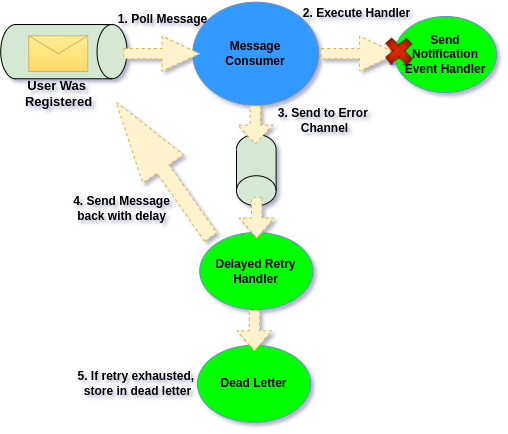
We may also want to try to recover before we consider Message to be stored in Dead Letter:
Storing Error Messages in Dead Letter only if retries are exhausted
{% tabs %}
{% tab title="Symfony" %}
**config/packages/ecotone.yaml**
```yaml
ecotone:
defaultErrorChannel: "errorChannel"
```
{% endtab %}
{% tab title="Laravel" %}
**config/ecotone.php**
```php
return [
'defaultErrorChannel' => 'errorChannel',
];
```
{% endtab %}
{% tab title="Lite" %}
```php
$ecotone = EcotoneLite::bootstrap(
configuration: ServiceConfiguration::createWithDefaults()
->withDefaultErrorChannel('errorChannel')
);
```
{% endtab %}
{% endtabs %}
and then we use inbuilt Retry Strategy:
```php
#[ServiceContext]
public function errorConfiguration()
{
return ErrorHandlerConfiguration::createWithDeadLetterChannel(
"errorChannel",
// your retry strategy
RetryTemplateBuilder::exponentialBackoff(1000, 10)
->maxRetryAttempts(3),
// if retry strategy will not recover, then send here
"dbal_dead_letter"
);
}
```
## Dead Letter Console Commands
### Help
Get more details about existing commands
{% tabs %}
{% tab title="Symfony" %}
```php
bin/console ecotone:deadletter:help
```
{% endtab %}
{% tab title="Laravel" %}
```
artisan ecotone:deadletter:help
```
{% endtab %}
{% endtabs %}
### Listing Error Messages
Listing current error messages
{% tabs %}
{% tab title="Symfony" %}
```php
bin/console ecotone:deadletter:list
```
{% endtab %}
{% tab title="Laravel" %}
```php
artisan ecotone:deadletter:list
```
{% endtab %}
{% tab title="Lite" %}
```php
$list = $messagingSystem->runConsoleCommand("ecotone:deadletter:list", []);
```
{% endtab %}
{% endtabs %}
### Show Details About Error Message
Get more details about given error message
{% tabs %}
{% tab title="Symfony" %}
```php
bin/console ecotone:deadletter:show {messageId}
```
{% endtab %}
{% tab title="Laravel" %}
```php
artisan ecotone:deadletter:show {messageId}
```
{% endtab %}
{% tab title="Lite" %}
```php
$details = $messagingSystem->runConsoleCommand("ecotone:deadletter:show", ["messageId" => $messageId]);
```
{% endtab %}
{% endtabs %}
### Replay Error Message
Replay error message. It will return to previous channel for consumer to pick it up and handle again.
{% tabs %}
{% tab title="Symfony" %}
```php
bin/console ecotone:deadletter:replay {messageId}
```
{% endtab %}
{% tab title="Laravel" %}
```php
artisan ecotone:deadletter:replay {messageId}
```
{% endtab %}
{% tab title="Lite" %}
```php
$messagingSystem->runConsoleCommand("ecotone:deadletter:replay", ["messageId" => $messageId]);
```
{% endtab %}
{% endtabs %}
### Replay All Messages
Replaying all the error messages.
{% tabs %}
{% tab title="Symfony" %}
```php
bin/console ecotone:deadletter:replayAll
```
{% endtab %}
{% tab title="Laravel" %}
```php
artisan ecotone:deadletter:replayAll
```
{% endtab %}
{% tab title="Lite" %}
```php
$messagingSystem->runConsoleCommand("ecotone:deadletter:replayAll", []);
```
{% endtab %}
{% endtabs %}
### Delete Message
Delete given error message
{% tabs %}
{% tab title="Symfony" %}
```php
bin/console ecotone:deadletter:delete {messageId}
```
{% endtab %}
{% tab title="Laravel" %}
```php
artisan ecotone:deadletter:delete {messageId}
```
{% endtab %}
{% tab title="Lite" %}
```php
$messagingSystem->runConsoleCommand("ecotone:deadletter:delete", ["messageId" => $messageId]);
```
{% endtab %}
{% endtabs %}
### Turn off Dbal Dead Letter
```php
#[ServiceContext]
public function dbalConfiguration()
{
return DbalConfiguration::createWithDefaults()
->withDeadLetter(false);
}
```
## Managing Multiple Ecotone Applications
The above solution requires running Console Line Commands. If we want however, we can manage all our Error Messages from one place using [Ecotone Pulse](/modelling/recovering-tracing-and-monitoring/ecotone-pulse-service-dashboard.md).
This is especially useful when we've multiple Applications, so we can go to single place and see if any Application have failed to process Message.
---
# Agent Instructions
This documentation is published with GitBook. GitBook is the documentation platform designed so that both humans and AI agents can read, navigate, and reason over technical content effectively. Learn more at gitbook.com.
## Querying This Documentation
If you need additional information that is not directly available in this page, you can query the documentation dynamically by asking a question.
Perform an HTTP GET request on the current page URL with the `ask` query parameter, and the optional `goal` query parameter:
```
GET https://docs.ecotone.tech/modelling/recovering-tracing-and-monitoring/resiliency/error-channel-and-dead-letter/dbal-dead-letter.md?ask=&goal=
```
`ask` is the immediate question: it should be specific, self-contained, and written in natural language.
`goal` is optional and describes the broader end goal you are ultimately trying to accomplish on behalf of the user. GitBook uses it to tailor the answer towards what is most useful for that goal.
The response will contain a direct answer to the question and relevant excerpts and sources from the documentation.
Use this mechanism when the answer is not explicitly present in the current page, you need clarification or additional context, or you want to retrieve related documentation sections.